Shielded Metal Arc Welding (SMAW), commonly known as stick welding, can operate using AC (Alternating Current) or DC (Direct Current) power sources. The choice of current and polarity affects arc stability, penetration, spatter levels, and overall weld quality.
AC vs DC in Stick Welding
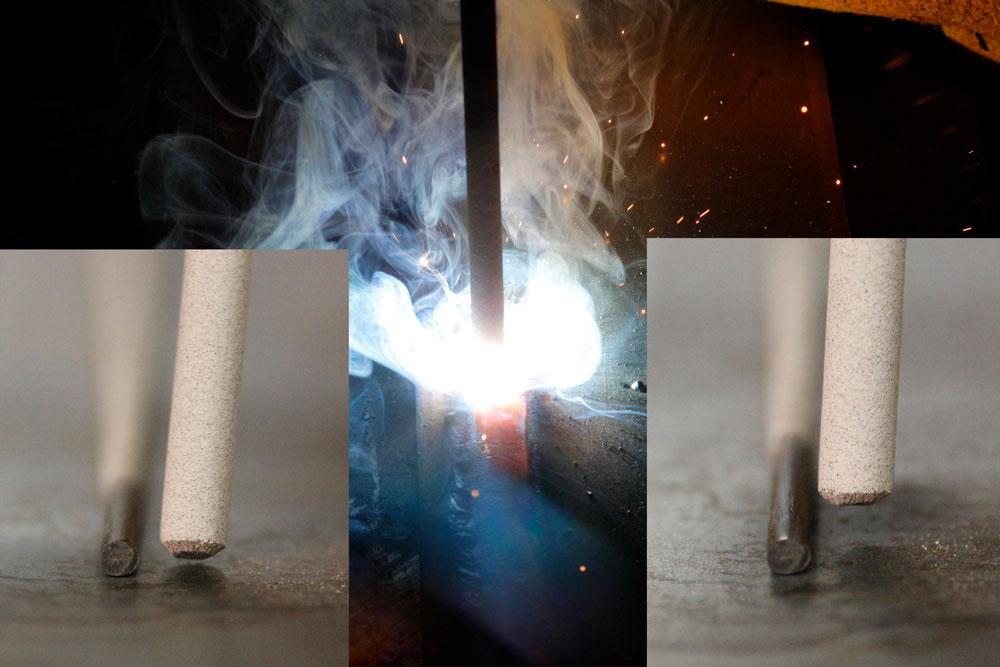


AC (Alternating Current)
Current alternates direction multiple times per second.
Advantages:
- Reduces arc blow (magnetic interference)
- Works well with basic AC-rated electrodes
- Suitable for general-purpose welding
Limitations:
- Less stable arc compared to DC
- Slightly more spatter
DC (Direct Current)
Current flows in one direction only.
Advantages:
- Smoother and more stable arc
- Easier arc starting
- Better penetration control
- Less spatter
Preferred for: precision and high-quality welds.
Understanding Polarity in DC Welding
In DC welding, polarity determines the direction of current flow and heat distribution.
1. DCEP (Direct Current Electrode Positive) — Reverse Polarity
Default for most stick electrodes
✔ Current flows from workpiece (–) to electrode (+)
✔ ~70% of heat concentrates at the workpiece
✔ Deeper penetration
✔ Stronger weld fusion
Common electrodes: E6010, E6011, E7018
👉 Most widely used polarity.
2. DCEN (Direct Current Electrode Negative) — Straight Polarity
✔ Current flows from electrode (–) to workpiece (+)
✔ Less penetration
✔ Faster deposition rate
✔ Suitable for thin metals
Used less frequently in stick welding.
Why DCEP Is Commonly Recommended
DCEP provides:
- Strong weld penetration
- Stable arc performance
- Reliable fusion in structural welding
- Better performance in vertical and overhead positions
This makes it ideal for most structural and heavy-duty applications.
Electrode Compatibility
Different electrodes are designed for specific currents:
- AC electrodes: E6011, E6013
- DCEP electrodes: E7018, E6010
- AC/DC compatible: E6013, E7018 AC
Always check electrode packaging for recommended polarity.
When to Use AC vs DC
Use AC when:
✔ Arc blow is a problem
✔ Using AC-only machines
✔ Performing general repairs
Use DC when:
✔ Precision and smooth arc are required
✔ Strong penetration is needed
✔ Welding out of position
✔ Working with thicker materials
Summary
Stick welding can be performed using both AC and DC current, but DC provides a smoother arc and better control. The most common polarity is Direct Current Electrode Positive (DCEP), which delivers deeper penetration and stronger welds. AC remains useful for reducing arc blow and general-purpose welding.
Choosing the correct current type and polarity ensures optimal weld strength, stability, and overall performance.